Idle staff while colour rests
Hair colour is 20 minutes of work and 40 minutes of waiting. During those 40 minutes the staff member drinks tea and the salon loses revenue.


The colour goes on, then everyone waits. During that wait the stylist is free, but the calendar still shows the chair as taken — and the salon quietly loses the hour. D-CCM keeps a service's working minutes and its waiting minutes apart: it brings you the job that fits inside the wait, and catches a clash before you save it. Whatever fits inside the wait is the capacity the salon gains.
The programs in common use count an appointment as one solid block; waiting is not something they recognise. That is exactly where D-CCM looks.
Problem
Average salon occupancy in Turkey is 62%. That means 38% of every staff hour goes empty. D-CCM looks at that gap.
Hair colour is 20 minutes of work and 40 minutes of waiting. During those 40 minutes the staff member drinks tea and the salon loses revenue.
Three customers land on the same hour, the room takes two, there is one piece of equipment. The front desk warns manually and the customer walks away unhappy.
The owner works it out on the fly: “I'll squeeze a manicure in while the colour sits.” Some days it lands, some days two customers are at the door at once. The software knows nothing about that plan.
Why it exists
The chair looks busy while the staff member is free. No second customer can be taken and the salon quietly loses that hour. The problem is not the software's arithmetic — it is its model.
The passive interval is opened deliberately. It becomes a separate slice in the calendar and, if a short job fits, it gets suggested. The day is saved and the customer notices nothing.
Solution
A service is no longer the name of a single block. It has two parts: the minutes a staff member is hands-on and the minutes the customer is waiting. D-CCM does not waste the second kind.
Hair colour: 20 minutes of work, 40 minutes of waiting. D-CCM sees those 40 minutes and points the same stylist at the customer beside them — a manicure, say. Two customers in that hour instead of one: the hour does double the work.
Setting it up
All it takes to switch D-CCM on is writing a service's two durations once. The calendar and the commission follow by themselves.
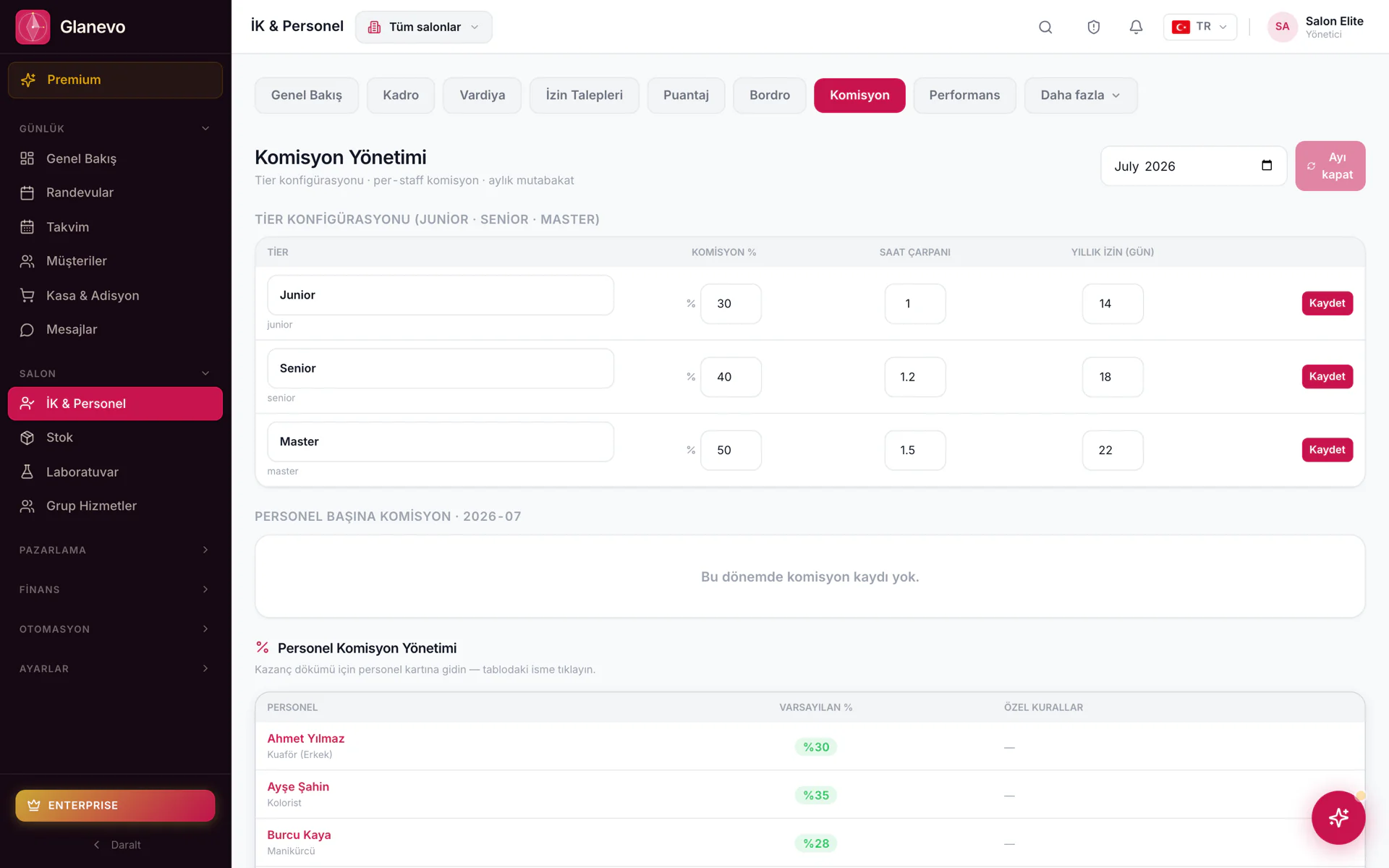
Commission management — tier configuration (Junior/Senior/Master) and the default rate per staff member. The earnings breakdown opens from the staff card.
How it works
The system knows the colour needs those 40 minutes. It does not write them off as empty — it finds the job that fits inside them and puts it in front of you. Nothing moves in the calendar until you say so.
One Tuesday afternoon
A good salon already does this in its head. The difference: in your head it works one day and falls apart the next — and at the end of the month, who did the blow-dry turns into an argument. Done by the system it holds every day, and it stays written down.
Results
Target pilot scenario (simulation): 12 salons, n=3,842 appointments. These are the results targeted against manual scheduling — once real pilot measurements are published, this section will be updated with its sources:
Comparison
The booking programs in common use all count an appointment as one solid block. D-CCM is the first to split the working minutes from the waiting ones.
Who it helps
D-CCM does not pay off equally in every salon. Let us be plain — where it is unnecessary, it stays off:
This is where you gain the most: long colour work with a short job beside it. The passive interval repeats several times a day.
If your protocols involve waiting, the interval logic pays off. If they do not, you leave it off and the menu stays simple.
Most shops do not need it; the work is already short and back to back. Turn it on if you offer hybrid colour services.
Roadmap
D-CCM runs inside Glanevo today; once the pilot salons start it will be tested against real appointments. What protects us is not a patent — it is working a little better every month, and the real data that will build up from salons.
Giving one service two separate durations, and catching a clash — working at its plainest.
Suggesting a job that fits inside the wait is working. Clash detection is tested automatically every day.
The same colour does not sit for the same time in every salon: hair thickness, the brand, how warm the room is — all of it shifts the number. The system will learn that in your salon and give you its own figure.
Running from its own region in each country. A patent application will be considered when the time is right.
FAQ
It is real and it runs: a service carries two separate durations, the calendar catches a clash before the booking is saved, and it offers the job that fits inside the wait. But the pilot figures on this page are not measurements yet — they are targets (simulation). When real salons produce numbers, we will put them here with their source.
Not with a patent. By keeping at it, by the real data that will build up from salons, and by being this far inside a salon's daily work. A patent application will be considered separately when the time is right.
Copying it takes years, because what would have to be copied is not one button: it is a way of splitting the salon's day in two. The calendar, commission, staff and till all have to be built around it. And we will not have stood still in the meantime.
Into growing the team, and into the system learning your salon's waiting times. The goal is to stop saying “colour sits for 40 minutes” and start saying “in your salon, this colour sits for 46”.
On Free it is limited to one staff member. From Pro upwards you get all of it: several staff, rooms and pieces of equipment; up to five options; automatic notifications. Studio and Enterprise add more than one branch.
You write the two durations of your services once — for colour, say, 20 minutes applying and 40 minutes waiting. The rest runs by itself: the system suggests, you approve it or change it.
Define the active and passive durations of your services once and leave the rest to D-CCM. At the end of the first week, measure the occupancy difference yourself.